Showing posts with label seafood. Show all posts

Friday, 21 October 2011

Sushi training

I learned the proper technique to make thin sushi rolls ( hosomaki ) and reverse sushi rolls ( uromaki) in London with Ikeida Atsuko quite a while ago,so  I decided a few weekends ago that I'd practice my technique. I cooked about 4 cups (600 grams) of rice.
(Big mistake , I had to make so much sushi and  because I also took photographs I spent more than 3 hours in the kitchen , haha ! )
( click on the pictures to see a larger version )
While the rice was cooking , I prepared strips of avocado ,cooked thin asparagus, strips of carrot, lightly cooked in a little water till they were done but still firm , strips of cucumber and strips of smoked and fresh fish ( tuna and salmon ) and surimi (aka imitation crab sticks). Too much of everything, but you can always eat what's left :)
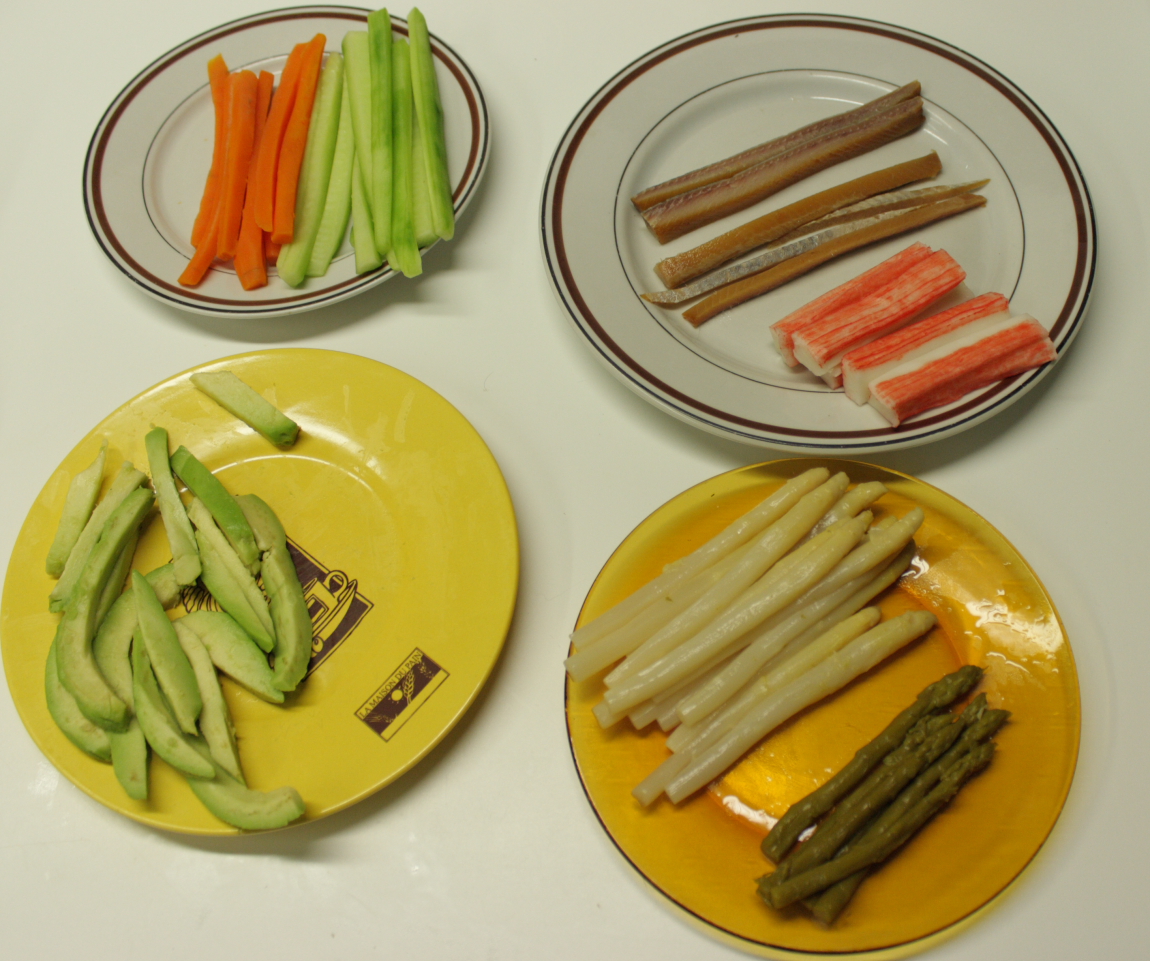


I also used strips cut from a fillet of smoked herring , because I like the flavor.


The warm rice is put in a hangiri (wooden tub) which has been rinsed well with water so the rice doesn't stick to it. Mine is about 40 cm wide.
(I had already used half the rice, before I took a picture.)

Then I add a mixture of 2 parts rice vinegar , 1 part sugar and a little salt ( for 600 uncooked grams of rice : 8 tablespoons rice vinegar, 4 (unheaped) spoons of white sugar and a teaspoon of salt ), using a spatula to fold it through the rice , while fanning it to cool down.


Fanning makes the rice nice and shiny. At first it usually appears too soggy and I used to worry that I put too much mixture on it, but I find it always absorbs the mixture. Keep the hangiri covered with a clean cloth or dishtowel to keep the rice from drying out.

To roll the reverse rolls (uramaki) you definitely need to cover a makisu (bamboo mat) with clingfilm, to keep the rice from sticking to the bamboo.
One uramaki , just made , on the clingfilm covered makisu.


For hygiene, I wear latex  gloves when making sushi ( I need XL size cause my hands are so big : I buy these from an industrial tools shop in town : most supermarkets only have S, M and L)
 

Traditionally hosomaki are made with one ingredient or at most two, but you can make them with three like me. These are from top left to right  tuna with carrot and cucumber and three with pickled herring and cucumber.
The uromaki underneath are salmon with carrot and cucumber and roasted sesame seed on the outside.


A hosomaki ( thin roll ) and an uromaki ( which traditionally is made square ). I'm still practicing on the squareness, even though the ones I see in Japan Center aren't that perfectly square either :)
Did you know you have to let sushi rolls with nori on the outside sit for several minutes before cutting them ? The nori absorbs some of the moisture of the rice , sticks better to the rolls and make it easier to cut.


Hosomaki with crab stick carrot and avocado. I used to use my very sharp sashimi knife to cut the rolls, but I found a very sharp deba (shown underneath ) is even better. I use Japanese Suehiro waterstones of 1000 and 6000 grain that let me get a razor sharp edge. If you're not used to sharpening and honing knives , have them sharpened. It's not easy to do it properly.


Two more uramaki rolls , the top one covered in sesame seed, the bottom one in fish roe.


The important thing about uramaki is that you have to keep wetting your hands : the rice sits on the outside and is very sticky. It's easy to forget and before you know the roll comes undone.

Not all my sushi works out though. I really like the rather large and beautiful rainbow trout caviare ( I use it a lot when making sashimi ), so I made a thick roll with rainbow trout on the outside. It still looked OK when in a roll, but when I cut it ,


all the eggs fell off : they didn't stick to the rice. Nothing to do with the rice, it was sticky enough.
Also, there was a bit too much filling.


I'm sure the Japanese have had the same experience with salmon roe, so I cut strips about 1 inch wide and 8 inches long. Out of a small golf-ball sized lump of sushi rice I shaped a flat round shape .,wound a strip of nori around it , leaving a little bit of nori around the top end to hold the roe.
A small dab of wasabi on the rice , arrange a coffee-spoon of roe on top.


Voila, my very first gunkan sushi ( battleship sushi) : the perfect solution to hold my beautiful caviar.


I liked them so much I immediately made four more.


You can wash the commercial packaging of sushi you buy in the shop in the dishwasher at 50 °C ( put the transparent tops flat, or they'll deform, the bottom are much stronger ) and package your sushi to take away.
These are thick uramaki with sesame on the outside ( 2 strips carrot, 2 strips raw salmon, 2 strip cucumber). They're harder to slice , because the rice isn't held together by a nori sheet on the outside. Use a sharp knife and clean it on a wet towel between each cut.

A few more  thick uramaki ( salmon, cucumber and carrot ) 


 Needless to say, I spent that evening and the next day eating LOTS of sushi !

Friday, 12 February 2010

Ngamantha Khayanchinthi si Piyan.

This is a very easy and tasty Vietnamese dish that's a favourite of mine and that I haven't made in a long time , but now it's making a comeback. In my kitchen anyway.


You need ( for 4 small eaters or 2 rather large ones )

2 small sharks (about 600 grams)
about 2 teaspoons of salt
2-3 tablespoons of oil (I use olive oil )

4-5 cloves garlic, crushed
( the ones in the picture aren't crushed yet )


1/2 tablespoon chopped fresh coriander
6
tablespoons tomato puree ( about 2 of these small cans )


the fresh juice of one lime ( I like adding a bit more like one and a half)


1 teaspoon chili flakes or 1 knife-point of powdered chili

2- 3 tablespoons or 70-100 ml water

In the example I use half of these to cook for 2 portions : this dish can be kept in the fridge for several days. If you restrain yourself from eating it all right away, that is.

This is the shark ( in Belgium it's called a dog shark , in fact it's the smallest of the cat shark family :)

For a very long time in Belgium it was usual to sell it as 'sea eel' (which is also more expensive) but that's illegal. Of course every good cook ( like me) knew it was shark all along ( eel doesn't have those telltale two fins on the back ).

Preheat an oven to 200 degrees Celsius.

Rub (massage ) your shark firmly all over with salt.

Cut it into equal pieces , about a finger long.

Oil a deep baking dish with about 1 tablespoon of oil. The dish needs to be deep enough so 3-4 cm remain unfilled to put the sauce on top.

I always push the fish cuts in vertically till the dish is filled ,

but if using only one shark, you can just arrange them in the bottom.

Heat a tablespoon of oil in a pan over medium heat ( electric 6-7)

and fry the garlic until the tips start to turn golden (light brownish). Not any longer because they'll fry on till you add the tomato puree. (Click on the picture for a closer look )

Add coriander ( it'll wilt and turn brown immediately), keep stirring for a minute

and then add tomato puree and lime juice.

Keep stirring on a medium heat for about 5 to 6 minutes.

Soon the sauce will give off an irresistible aroma, which "will create total confidence in the cook" (quote from original recipe ).
Taste and stir in a bit more lime juice if you like.


Pour a few tablespoons of water in the dish , enough so it'll cook the fish.

Use a spoon and a spatula to arrange the sauce on top of the fish.

TIP : This is a messy sauce. Do NOT DO this wearing your finest silk blouse or kimono, you'll never get the spots out.

Sprinkle over the chili flakes or powder.

I use chili pepper I bought in Mexico, it's very hot so one (large) knife tip is enough.

Set the oven to 220 degrees Celsius and bake for 25 - 30 minutes. This smaller amount only takes 20 minutes.

The exact cooking time will depend on the size of the pieces of shark, but you can tell when the dish is ready by probing the flesh with a bamboo skewer: if it slides in easily all the way, it's done.
Done ! You can see a few brighter spots where the water has been bubbling through from below.

The meat is moist and melts in your mouth and it goes so well with the slightly spicy- slightly limy tomato sauce. Delicious ! ( click on picture for a larger view : ah! I wish you could smell it : )

I find this dish is even delicious cold straight out of the fridge ( I used to eat it between loafs of bread in the summer )

As much as I like eating shark, after seeing the horror stories of sharks having their fins cut off and left to die in the sea, I will never eat or tolerate the eating of shark fin soup for the rest of my life. If you need to kill an animal ,do it swiftly and eat all of it.